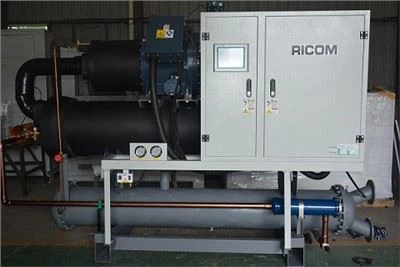
Hey there! As a supplier of open scroll chillers, I often get asked about refrigerant leakage detection methods. It's a crucial aspect of maintaining the efficiency and safety of these chillers, so I thought I'd share some insights on the topic.
First off, let's understand why refrigerant leakage detection is so important. Refrigerants play a vital role in the cooling process of open scroll chillers. They absorb heat from the water or air being cooled and release it outside. However, if there's a leak, not only does it reduce the chiller's cooling capacity, but it can also harm the environment. Many refrigerants are greenhouse gases, and their release into the atmosphere contributes to global warming.
Now, let's dive into the different methods of detecting refrigerant leakage in open scroll chillers.
Visual Inspection
This is the simplest and most basic method. It involves a thorough visual check of the chiller components, including the refrigerant lines, joints, valves, and connections. Look for signs of oil stains or residue around these areas. Refrigerants often carry a small amount of lubricating oil with them, so if there's a leak, you might see an oily spot. Also, check for any visible damage, such as cracks or holes in the refrigerant lines. Keep an eye out for bubbles in the refrigerant sight glass, which could indicate a low refrigerant level due to a leak.


Soap Bubble Test
The soap bubble test is a cost - effective and easy - to - perform method. You'll need a solution of soapy water. Mix a small amount of liquid soap with water in a spray bottle. Then, spray the soapy solution on the suspected areas of the refrigerant system, like the joints and connections. If there's a refrigerant leak, the escaping gas will create bubbles in the soapy solution. This method is great for detecting small leaks that might not be visible during a visual inspection. It's also a good way to confirm a suspected leak before moving on to more advanced detection methods.
Electronic Leak Detectors
Electronic leak detectors are more sophisticated tools. They work by detecting the presence of refrigerant gas in the air. There are different types of electronic leak detectors, such as heated diode detectors and infrared detectors. Heated diode detectors are sensitive to most common refrigerants. They have a sensor that reacts to the refrigerant molecules in the air, and when a leak is detected, the detector will emit an audible or visual alarm. Infrared detectors, on the other hand, are more accurate and can detect very small leaks. They use infrared light to detect the specific absorption characteristics of refrigerant gases. These detectors are a bit more expensive but are well worth the investment for professional maintenance teams.
Ultrasonic Leak Detectors
Ultrasonic leak detectors are another option. They detect the high - frequency sound waves produced by the escaping refrigerant gas. When a refrigerant leaks from a small hole or crack, it creates a hissing sound at a frequency that's usually beyond the range of human hearing. The ultrasonic leak detector can pick up these sounds and convert them into an audible signal that you can hear through headphones. This method is particularly useful for detecting leaks in hard - to - reach areas or in noisy environments.
Pressure Testing
Pressure testing involves pressurizing the refrigerant system with an inert gas, such as nitrogen. First, you need to isolate the refrigerant system and connect a pressure gauge. Then, slowly introduce the nitrogen into the system until it reaches a specified pressure. Monitor the pressure gauge over a period of time. If the pressure drops, it indicates a leak in the system. This method can help you identify large leaks, but it doesn't tell you exactly where the leak is located. After pressure testing, you may need to use other methods, like the soap bubble test or an electronic leak detector, to pinpoint the leak.
As an open scroll chiller supplier, I've seen firsthand the importance of regular refrigerant leakage detection. It not only helps in maintaining the performance of the chiller but also extends its lifespan. By detecting and fixing leaks early, you can avoid costly repairs and ensure that your chiller operates at peak efficiency.
If you're in the market for an open scroll chiller, we offer a wide range of options. Check out our Open Water Cooled Screw or Scroll Chiller and Open Air Cooled Screw or Scroll Chiller for more details.
Whether you're a new buyer or looking to upgrade your existing chiller, our team is here to assist you. We can provide you with all the information you need about refrigerant leakage detection and other maintenance aspects. Don't hesitate to reach out if you have any questions or if you're interested in discussing a purchase. We're always happy to help you find the right chiller for your needs.
References
- ASHRAE Handbook - Refrigeration. American Society of Heating, Refrigerating and Air - Conditioning Engineers.
- HVAC&R Equipment Maintenance Manual. McGraw - Hill Professional.