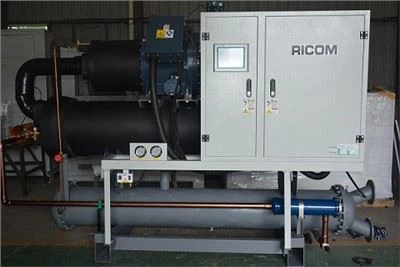
In the world of industrial climate control, water cooled screw chillers are renowned for their cooling capabilities. However, many wonder about their heating capacity. As a leading supplier of water cooled screw chillers, I'm here to shed light on this topic and provide a comprehensive overview of the heating potential of these remarkable machines.
Understanding the Basics of Water Cooled Screw Chillers
Before delving into the heating capacity, it's essential to understand the fundamental operation of water cooled screw chillers. These chillers use a screw compressor, which is a type of positive displacement compressor. The screw compressor works by trapping refrigerant gas between two helical rotors, compressing it, and then discharging it at a higher pressure and temperature.
The cooling process involves the refrigerant absorbing heat from the process water or air, which is then transferred to the cooling water in the condenser. This heat is ultimately dissipated into the environment through a cooling tower or other heat rejection system. But what about heating? Can these chillers reverse the process to provide heating?
The Heating Principle of Water Cooled Screw Chillers
Yes, water cooled screw chillers can be configured to provide heating through a process known as heat recovery or by using a heat pump cycle. In heat recovery systems, the waste heat generated during the cooling process is captured and reused for heating purposes. This is an energy - efficient way to utilize the heat that would otherwise be wasted.
In a heat pump cycle, the chiller can reverse the flow of refrigerant, effectively turning the evaporator into a condenser and vice versa. When the chiller operates in heating mode, the refrigerant absorbs heat from a low - temperature source (such as the ambient air or ground) and releases it at a higher temperature to the process water or air that needs to be heated.
Factors Affecting the Heating Capacity
Several factors influence the heating capacity of a water cooled screw chiller. These include:
Compressor Capacity
The size and efficiency of the screw compressor play a crucial role in determining the heating capacity. A larger compressor can handle more refrigerant flow and compress it to a higher pressure, resulting in more heat being transferred. For example, a high - capacity Screw Compressor Chiller can provide significant heating output, making it suitable for large - scale industrial applications.
Refrigerant Properties
Different refrigerants have different thermodynamic properties, which affect their ability to absorb and release heat. The choice of refrigerant can impact the heating efficiency and capacity of the chiller. For instance, some refrigerants have a higher heat - transfer coefficient, which means they can transfer heat more effectively.
Ambient Conditions
The temperature and humidity of the ambient environment can affect the performance of the chiller in heating mode. In colder climates, the chiller may need to work harder to extract heat from the low - temperature source. Additionally, high humidity can lead to frost formation on the evaporator coils, reducing the efficiency of the heat transfer process.
System Design
The overall design of the chiller system, including the size and configuration of the heat exchangers, the piping layout, and the control system, can also influence the heating capacity. A well - designed system will ensure efficient heat transfer and proper refrigerant flow, maximizing the heating output.
Calculating the Heating Capacity
The heating capacity of a water cooled screw chiller is typically measured in kilowatts (kW) or British thermal units per hour (BTU/h). To calculate the heating capacity, several parameters need to be considered, such as the mass flow rate of the refrigerant, the specific heat capacity of the refrigerant, and the temperature difference between the inlet and outlet of the heat exchanger.
The basic formula for calculating the heating capacity (Q) is:
[Q = m\times c\times\Delta T]
where (m) is the mass flow rate of the refrigerant, (c) is the specific heat capacity of the refrigerant, and (\Delta T) is the temperature difference across the heat exchanger.
However, in real - world applications, the calculation is more complex and may require the use of specialized software or the expertise of a professional engineer.


Applications of Heating with Water Cooled Screw Chillers
The heating capacity of water cooled screw chillers makes them suitable for a variety of applications, including:
Industrial Processes
Many industrial processes require both cooling and heating. For example, in the food and beverage industry, water cooled screw chillers can be used to cool the production equipment during the manufacturing process and then provide heating for cleaning and sanitization procedures. Screw Type Chiller systems are often preferred in these applications due to their reliability and efficiency.
HVAC Systems
In commercial and industrial buildings, water cooled screw chillers can be integrated into the heating, ventilation, and air conditioning (HVAC) systems. They can provide both cooling in the summer and heating in the winter, reducing the need for separate heating and cooling equipment. This not only saves space but also improves energy efficiency.
District Heating
In large - scale district heating systems, water cooled screw chillers can be used to recover waste heat from industrial processes or power plants and distribute it to nearby buildings for heating purposes. This is an environmentally friendly way to utilize waste energy and reduce the overall carbon footprint.
Advantages of Using Water Cooled Screw Chillers for Heating
There are several advantages to using water cooled screw chillers for heating:
Energy Efficiency
By recovering waste heat or using a heat pump cycle, water cooled screw chillers can significantly reduce energy consumption compared to traditional heating systems. This can lead to substantial cost savings over time.
Flexibility
These chillers can be easily configured to provide both cooling and heating, offering a versatile solution for various applications. They can also be integrated with existing HVAC or industrial systems.
Reliability
Screw compressors are known for their durability and reliability. Water cooled screw chillers are designed to operate continuously for long periods, making them a dependable choice for industrial and commercial applications.
Our Offerings as a Water Cooled Screw Chiller Supplier
As a supplier of water cooled screw chillers, we offer a wide range of products with different heating capacities to meet the diverse needs of our customers. Our Water Chiller With Pump systems are designed with the latest technology to ensure high efficiency and reliable performance.
We also provide comprehensive technical support and after - sales service. Our team of experienced engineers can help you select the right chiller for your application, install the system, and provide ongoing maintenance and troubleshooting.
Contact Us for Your Heating and Cooling Needs
If you're interested in learning more about the heating capacity of our water cooled screw chillers or have any other questions about our products, we encourage you to contact us. Our sales team is ready to assist you in finding the perfect solution for your industrial or commercial climate control requirements. Whether you need a small - scale chiller for a laboratory or a large - capacity system for an industrial plant, we have the expertise and products to meet your needs.
References
- ASHRAE Handbook - HVAC Systems and Equipment. American Society of Heating, Refrigerating and Air - Conditioning Engineers.
- Thermodynamics: An Engineering Approach. Yunus A. Cengel and Michael A. Boles.