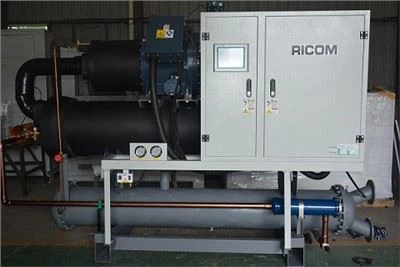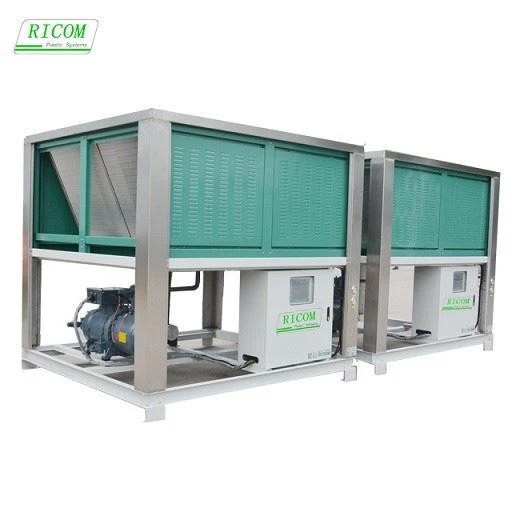
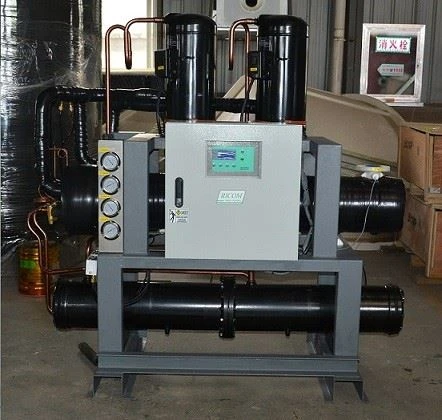
The water chiller machine is a cooling water equipment that can provide constant temperature, constant current and constant pressure.

Working principle
The industry is commonly known as freezer, ice water machine, water chiller machine, cooler, etc., because it is widely used in all walks of life, so there are countless names. The principle of its nature is that of a multifunctional machine that removes the liquid vapor through a compression or heat absorption refrigeration cycle. The vapor-compression chiller consists of four main components in the form of vapor-compression refrigeration cycle compressor, evaporator, condenser, and part metering device to achieve different refrigerants. The absorption chiller uses water as the refrigerant and relies on the strong affinity between the water and the lithium bromide solution to achieve the cooling effect.
The working principle of the water chiller machine is vapor compression refrigeration, that is, it uses the principle of absorbing heat when the liquid refrigerant vaporizes and releasing heat when the vapor condenses. In refrigeration technology, evaporation is the process by which a liquid refrigerant turns into a gaseous state when it boils. The change from liquid to gas can only be achieved by absorbing heat energy from the outside, so it is an endothermic process. The temperature at which the liquid refrigerant evaporates and vaporizes is called the evaporation temperature. Condensation refers to the cooling of the vapor to be equal to or lower than the saturation temperature to convert the vapor into a liquid state.
System flow diagram

Figure 1- Principle flow chart of air-cooled chiller

Figure 2- Principle flow chart of water cooled chiller
(Explanation: Figure 1-Air-cooled chiller uses a shell-and-tube evaporator to exchange heat between water and refrigerant. The refrigerant system absorbs the heat load from the water, cools the water to produce cold water, and then transfers the heat to the air through the action of the compressor. The finned condenser is then dissipated into the outside air by the cooling fan (wind cooling); Figure 2 - The water-cooled chiller uses a shell and tube evaporator to exchange heat between water and refrigerant, and the refrigerant system absorbs the heat load from the water After cooling the water to produce cold water, the heat is brought to the shell-and-tube condenser through the action of the compressor, and the refrigerant exchanges heat with the water, so that the water absorbs the heat and takes the heat out of the external cooling tower through the water pipe for dissipation (water cooling )
As shown in the figure, at the beginning, the low-temperature and low-pressure refrigerant gas after evaporative refrigeration is sucked by the compressor, and then compressed into high-temperature and high-pressure gas and sent to the condenser; after the high-pressure and high-temperature gas is cooled by the condenser, the gas is condensed into a normal temperature and high pressure liquid; when the normal temperature and high pressure liquid is It flows into the thermal expansion valve, is throttled into low-temperature and low-pressure wet vapor, flows into the shell-and-tube evaporator, absorbs the heat of the chilled water in the evaporator, and reduces the water temperature; the evaporated refrigerant is sucked back into the compressor, and repeated The next refrigeration cycle, so as to achieve the purpose of refrigeration.
Construction and composition of components
There are four main components in the basic refrigeration system of the chiller: compressor, evaporator, condenser, and expansion valve. In addition, in order to improve the performance of the refrigeration system and achieve better performance, there are usually many auxiliary devices: liquid pipeline solenoid valve, sight glass, liquid pipeline drier filter, high and low pressure controller, etc. The following is an introduction to the structural components of the chiller:

Types of compressors
1. Compressor
In the chiller system, the compressor is the power to ensure refrigeration. The compressor is used to increase the pressure of the refrigerant in the system, so that the refrigerant circulates in the refrigeration system to achieve the purpose of refrigeration. Compressors are divided into three categories according to their structure: open type, semi-closed type, and fully closed type. At present, most of the chillers with chilled water above 0°C in industrial chillers use fully-hermetic compressors, and low-temperature chillers with chilled water below 0°C use semi-hermetic compressors (commonly include screw type and reciprocating type) , and open chillers are generally used in refrigeration systems where the refrigerant is ammonia.
A hermetic refrigeration compressor is a compressor and an electric motor, which are installed in a closed iron shell as a whole. From the outside, there are only the suction and exhaust pipe joints of the compressor and the wires of the motor; the compressor shell is divided into two parts, the upper and lower parts. After the compressor and the motor are installed, the upper and lower iron shells are welded together by electric welding. Usually can not be disassembled, so the machine is reliable to use. In hermetic refrigeration compressors, there are piston compressors and scroll compressors.
The structure of the fully enclosed scroll refrigeration compressor is mainly composed of the following items: rotary inlet and outlet valves; pressure gauge interface; built-in overload protection; elastic frame; crankcase heater; built-in lubricating oil pump.
The biggest advantages of scroll refrigeration compressors are: 1. Simple structure: the compressor body only needs 2 components (moving plate, fixed plate) to replace 15 components in the piston compressor; 2. High efficiency: suction gas and conversion processing The gases are separated to reduce heat transfer between suction and treatment, which can improve compressor efficiency. Both the scroll compression process and the shifting process are very quiet.


Types of condensers
2. Condenser
The high-temperature and high-pressure freon of the refrigeration system enters the condenser after coming out of the compressor, releasing a lot of heat to the cooling medium and being cooled and liquefied. Then, the condenser can be divided into three types according to its cooling form: water-cooled, air-cooled, evaporative and water-sprayed.
2-1. Water-cooled type:
In water-cooled condenser, the heat released by refrigerant is carried away by cooling water. Cooling water can flow once, or can be recycled. When circulating water is used, a cooling tower or cold pool is required. Water cooling condenser has shell and tube type, casing type, immersion type and other structural forms.
Shell and tube condenser is commonly used in water-cooled chiller. The shell is made of steel pipe with a thickness of more than 5mm. After anti-rust treatment, it can withstand pressure of 20Kg/ cm2. The heat exchange tube is made of seamless copper tube with high efficiency, withstanding pressure of 10 Kg/ cm2. The two ends of the cap can be interchanged to change the direction of the water pipe. The water pipe flow is multi-loop, and the capacity of each condenser and compressor is coordinated. Square centimeter deG C -1 scaling factor, condenser water pressure drop does not exceed 6.5MAq, straight through water pipe easy to clean and maintain.
2-2. Air-cooled type:
In an air-cooled condenser, the heat released by the refrigerant is carried away by the air. Its structure form is mainly composed of a number of groups of copper tubes, because the air heat transfer performance is very poor, it is usually in the copper tube to increase the fin, in order to increase the heat transfer area of the air side, at the same time, the ventilator is used to accelerate the air flow, the air forced convection to increase the heat dissipation effect.
2-3. Evaporating type and splashing type:
In this type of condenser, the refrigerant is condensed in the tube, and the water and air are cooled outside the tube at the same time.


3. Evaporator
When the freon liquid in the refrigeration system enters the expansion valve to be throttled and then sent to the evaporator, it belongs to the vaporization process. At this time, it needs to absorb a lot of heat, so that the temperature of the cooled price is gradually reduced, so as to achieve the effect of cooling and cooling. Then, according to the type of medium to be cooled, it can be divided into two categories: evaporators for cooling liquid (water) (dry evaporators) and evaporators for cooling air (surface-cooled evaporators).
The main introduction here is the evaporator used in the chiller refrigeration system, which is generally a dry shell and tube evaporator. The refrigerant evaporates in the heat exchange tube, and the water flows on the side of the shell and tube. In order to increase the heat exchange efficiency, a 2mm thick water baffle is set on the side of the shell and tube, so that the water can flow back and forth from side to side to achieve the purpose of producing ice brine. The shell of the container is more than 6mm thick. It is made of steel pipe and can withstand pressure of 10 Kg/square centimeter. The exterior is insulated with PE foam board. The heat exchange tube is made of high-efficiency seamless red copper tube, which is processed into an internally threaded ribbed tube through an embossing process, which increases the heat transfer area and improves the heat transfer efficiency, with a pressure resistance of 20 Kg/square centimeter; The heat exchange tube and the end plate are combined with the expansion tube, and the partition plate is added in the end cover to make the refrigerant flow into multiple paths to keep the refrigeration oil flowing back. It can tolerate a scaling factor of 0.086 M2℃/KW, and the water pressure drop through the evaporator does not exceed 6.5mAq.

4. Thermal expansion valve
In the flow chart of the refrigerant system of the chiller, we find that there is a small part called the thermal expansion valve between the outlet of the condenser and the inlet of the evaporator. It is a part of throttling and reducing pressure, so that the condensing pressure of the refrigerant is reduced to the evaporation pressure, so it plays an indispensable role in the refrigeration system. It and refrigeration compressor, evaporator, condenser, and called the refrigeration system four components.
4-1. Structure of thermal expansion valve
The top of the expansion valve is composed of a sealed box cover corrugated film temperature sensor package and a capillary tube to form a closed container, which is filled with Freon to become an induction mechanism. The refrigerant injected into the induction mechanism can be the same as that of the refrigeration system, or it can be different. For example, the refrigeration system F-22 is used, and the temperature sensor can be filled with F-12 or F-22. The temperature sensor is used to sense the temperature of the superheated steam at the outlet of the evaporator. The capillary is used as the connection between the sealing box and the temperature sensor. On the diaphragm, the wave diaphragm is stamped and formed by a thin alloy sheet of about 0.2mm, and the section is wavy. The elastic deformation performance is very good after being stressed. The adjusting rod is used to adjust the opening superheat of the expansion valve. It is used to adjust the elastic force of the spring during the debugging process. When the adjusting rod is rotated inward, the spring is pressed tightly, and the adjusting rod is rotated outward. When the spring is loosened, the transmission rod pushes against the valve needle seat and the transmission disc to transmit pressure. The valve needle seat is equipped with a valve needle to open or close the valve hole.
4-2. The working principle of the thermal expansion valve
The expansion valve senses the change of the superheat at the outlet of the evaporator through the temperature sensing bulb, resulting in the temperature sensing system (the temperature sensing system is composed of several interconnected parts such as the temperature sensing bulb, capillary tube, transmission diaphragm and transmission bellows). Closed system) filling material produces pressure changes and acts on the transmission diaphragm. Promote the diaphragm to form an up and down displacement, and then transmit this force to the transmission rod through the transmission plate to push the valve needle to move up and down, so that the valve closes or opens large, which plays the role of pressure reduction and throttling and automatically adjusts the refrigerant supply to the evaporator. And keep the outlet end of the evaporator with a certain degree of superheat, so as to ensure the full utilization of the heat transfer area of the evaporator and reduce the occurrence of the phenomenon of liquid shock.
4-3. Types of expansion valves (internal balance, external balance)
The pressure acting on the lower part of the transmission diaphragm in the thermal expansion valve body is the throttling evaporation pressure (this pressure enters the space under the diaphragm through the gap between the transmission rod and the transmission plate). This structure is called an internal balance expansion valve. The pressure acting on the lower part of the transmission diaphragm in the thermal expansion valve is not the evaporation pressure after throttling, but a valve that introduces the pressure at the outlet of the evaporator into the lower space structure of the transmission diaphragm through an external balance pipe, which is called an external balance thermal expansion valve. . Compared with the internal balance type expansion valve, the superheat degree of the external balance type thermal expansion valve is much smaller, so when the external balance type thermal expansion valve is used, the effect of the heat transfer area of the evaporator can be fully exerted and the effect of the refrigeration device can be improved. , When the resistance of the evaporator is small and the pressure loss is not large, the internal balance thermal expansion valve can be selected; when the evaporation resistance is large, the pressure loss is relatively large or there is a liquid distributor, the external balance thermal expansion valve should be selected. . For distributors, externally balanced expansion valves are generally used. Externally balanced thermal expansion valves are usually used in chillers of refrigeration equipment.
5. Other accessories
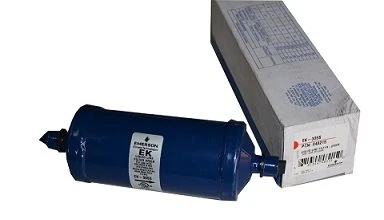
5-1. Liquid pipe dryer filter
Usually liquid line filter driers are not removable. The interior adopts molecular sieve structure, which can remove a small amount of impurities and moisture in the pipeline, and achieve the purpose of purifying the system. Due to the oxides appearing in the welding of the pipeline, and the purity of the Freon refrigerant is also different, the Freon refrigerant we use is required to be imported. When the liquid pipeline drier filter is blocked, the suction pressure will decrease, and there will be a temperature difference between the two ends of the filter. If this happens, the filter needs to be replaced.

5-2. High and low pressure controller
The high and low pressure controller is a protective device in the refrigeration system. The high-pressure protection is the upper limit protection. When the high-pressure pressure reaches the set value, the high-pressure controller is disconnected, so that the compressor contactor coil is released, and the compressor stops working, so as to avoid damage to parts when running under ultra-high pressure. The high pressure protection is reset manually. When the compressor is to be started again, the reset button must be pressed first. Of course, before restarting the compressor, the cause of the high high pressure should be checked first, and the machine can run normally only after being ruled out.
Low pressure protection is a protection device set up to prevent the refrigeration system from operating under too low pressure. Its settings are divided into high limit and low limit. Its control principle is: the low pressure disconnection value is the pressure difference value between the upper and lower limits, and the restart value is the upper limit. The low-pressure controller is automatically reset, so the operator is required to observe the operation of the machine frequently, and deal with it in time when an alarm occurs, so as to prevent the compressor from starting and stopping frequently for a long time and affecting its life.
Product parameters(R407C)
Technical Parameters of Water Cooled Scroll Chiller(Ⅰ) | |||||||
Model | SCW-05 | SCW-08 | SCW-10-Ⅱ | SCW-15-Ⅲ | SCW-20-Ⅱ | SCW-25-Ⅱ | |
Refrigerating capacity (Kcal/lKw/Rt/h) | 15093Kcal 17.55KW 4.99RT | 24148Kcal 28.08KW 7.98RT | 30186Kcal 35.1KW 9.98RT | 45279Kcal 52.65KW 14.97RT | 60372Kcal 70.2KW 19.96RT | 75465Kcal 87.75KW 24.95RT | |
Refrigerant | R407C | ||||||
compressor power(Hp) | 5 | 8 | 10 | 15 | 20 | 25 | |
Circulating pump power(Hp) | 0.75 | 1 | 1/1.5 | 1.5/2 | 1.5/2 | 2/3 | |
Piping of cooling water system | pipe diameter | 1" | 1.5" | 1.5" | 2" | 2" | 2.5" |
Flow(m³/h) | 3.4 | 5.5 | 6.85 | 9.3 | 12.7 | 15.1 | |
Chilled drainage piping | pipe diameter | 1" | 1.5" | 1.5" | 2" | 2" | 2.5" |
Flow(m³/h) | 2.74 | 4.27 | 4.27 | 8.59 | 8.59 | 14.55 | |
supply voltage | AC380V50HZ3PH AC440V50HZ3PH AC220V60HZ3PH | ||||||
Description: 1.The cooling capacity is based on evaporating temperature: 7℃, condenser temperature: 40℃, refrigerant: R407C, cooling water temperature: 32-37℃ 2.Optional refrigerant:R134A / R404A / R22 | |||||||
Technical Parameters of Water Cooled Scroll Chiller(Ⅱ) | ||||||
Model | SCW-30-Ⅱ | SCW-40 | SCW-50 | SCW-60 | SCW-80 | |
Refrigerating capacity (Kcal/lKw/Rt/h) | 90558Kcal 105.3KW 29.94RT | 120744Kcal 140.4KW 39.92RT | 150930Kcal 175.5KW 49.9RT | 181116Kcal 210.6KW 59.88RT | 241488Kcal 280.8KW 79.84RT | |
Refrigerant | R407C | |||||
compressor power(Hp) | 30 | 40 | 50 | 60 | 80 | |
Circulating pump power(Hp) | 3/4 | 40HP and above are configured according to customer requirements | ||||
Piping of cooling water system | pipe diameter | 2.5" | 3" | 3" | 4" | 4" |
Flow(m³/h)
| 18.5 | 24.5 | 30.2 | 36.2 | 48.2 | |
Chilled drainage piping | pipe diameter | 2.5" | 3" | 3" | 4" | 4" |
Flow(m³/h) | 14.55 | 22.06 | 22.06 | 42.2 | 42.2 | |
supply voltage | AC380V50HZ3PH AC440V50HZ3PH AC220V60HZ3PH | |||||
Description: 1.The cooling capacity is based on evaporating temperature: 7℃, condenser temperature: 40℃, refrigerant: R407C, cooling water temperature: 32-37℃ 2.Optional refrigerant:R134A / R404A / R22 | ||||||
Technical Parameters of Air - Cooled Scroll Chiller(Ⅰ) | |||||||
Model | SCA-05 | SCA-08 | SCA-10-Ⅱ | SCA-15-Ⅲ | SCA-20-Ⅱ | SCA-25-Ⅱ | |
Refrigerating capacity (Kca/lKw/Rt/h) | 13583.7Kca 15.8KW 4.5Rt | 21733.2Kca 25.3KW 7.2Rt | 27167.4Kca 31.59KW 9Rt | 40751.1Kca 47.4KW 13.5Rt | 54334.8Kca 63.18KW 18Rt | 67918.5Kca 79KW 22.5Rt | |
Refrigerant | R407C | ||||||
compressor power(HP) | 5 | 8 | 10 | 15 | 20 | 25 | |
Circulating pump power(Hp) | 0.75 | 1 | 1/1.5 | 1.5/2 | 1.5/2 | 2/3 | |
Cooling fan | Diameter(mm) | 550 | 600 | 500 | 550 | 600 | 630 |
Air Volume(m³/h )
| 6487 | 10820 | 2*6264 | 2*8487 | 2*10820 | 2*12220 | |
Chilled drainage piping | Pipe diameter | 1" | 1.5" | 1.5" | 2" | 2" | 2.5" |
Flow(m³/h) | 2.74 | 4.27 | 4.27 | 8.59 | 8.59 | 14.55 | |
Supply voltage | AC380V50HZ3PH AC440V50HZ3PH AC220V60HZ3PH | ||||||
Description: 1.The cooling capacity is based on evaporating temperature: 7℃, condenser temperature: 50℃, refrigerant: R407C, cooling water temperature: 32-37℃ 2.Optional refrigerant:R134A / R404A / R22 | |||||||
Technical Parameters of Air - Cooled Scroll Chiller(Ⅱ) | ||||||
Model | SCA-30-Ⅱ | SCA-40 | SCA-50 | SCA-60 | SCA-80 | |
Refrigerating capacity (Kcal/h) | 81502.2Kca 94.77KW 27Rt | 108669.6Kca 126.36KW 36Rt | 135837Kca 158KW 45Rt | 163004.4Kca 189.5KW 53.9Rt | 217339.2Kca 252.72KW 71.9Rt | |
Refrigerant | R407C | |||||
Compressor power(HP) | 30 | 40 | 50 | 60 | 80 | |
Circulating pump power(Hp) | 3/4 | 40HP以上根据客户要求配置 40HP and above are configured according to customer requirements | ||||
Cooling fan | Diameter(mm) | 700 | 750 | 630 | 700 | 750 |
Air Volume(m³/h)
| 2*15000 | 2*19000 | 3*12220 | 3*15000 | 3*19000 | |
Chilled drainage piping | Pipe diameter | 2.5" | 3" | 3" | 4" | 4" |
Flow(m³/h) | 14.55 | 22.06 | 22.06 | 42.2 | 42.2 | |
Supply voltage | AC380V50HZ3PH AC440V50HZ3PH AC220V60HZ3PH | |||||
Description: 1.The cooling capacity is based on evaporating temperature: 7℃, condenser temperature: 50℃, refrigerant: R407C, cooling water temperature: 32-37℃ 2.Optional refrigerant:R134A / R404A / R22 | ||||||
Technical Parameters of Water - Cooled Screw Chiller(Ⅰ) | |||||||
Model | RC2-40W | RC2-50W | RC2-60W | RC2-80W | RC2-90W | RC2-100W | |
Refrigerating capacity (Kca/lKw/Rt/h) | 119282Kca 138.7KW 39.4Rt | 154026Kca 179.1KW 50.9Rt | 172946Kca 201.1KW 57.2Rt | 229878Kca 267.3KW 76Rt | 287670Kca 334.5KW 95.1Rt | 314502Kca 365.7KW 104Rt | |
Refrigerant | R407C | ||||||
Compressor Power(Hp) | 40 | 50 | 60 | 80 | 90 | 100 | |
Supply voltage | AC380V50HZ3PH AC440V50HZ3PH AC220V60HZ3PH | ||||||
Energy regulation mode | 25%-50%-75%-100% | ||||||
Starting mode | Y/▲ | Y/▲ | Y/▲ | Y/▲ | Y/▲ | Y/▲ | |
Piping of cooling water system | Pipe diameter | 3" | 3" | 3" | 3" | 4" | 4" |
Chilled drainage piping | Pipe diameter | 3" | 3" | 3" | 3" | 4" | 4" |
Description: 1.The cooling capacity is based on evaporating temperature: 7℃, condenser temperature: 40℃, refrigerant: R407C, cooling water temperature: 32-37℃ 2.Optional refrigerant:R134A / R404A / R22 | |||||||
Technical Parameters of Water - Cooled Screw Chiller(Ⅱ) | |||||||
Model | RC2-110W | RC2-120W | RC2-140W | RC2-150W | RC2-160W | RC2-180W | |
Refrigerating capacity (Kcal/h) | 343742Kca 399.7KW 113.6Rt | 371004Kca 431.4KW 122.7Rt | 439030Kca 510.5KW 145.2Rt | 463540Kca 539KW 153.3Rt | 512818Kca 596.3KW 169.5Rt | 571470Kca 664.5KW 188.9Rt | |
Refrigerant | R407C | ||||||
Compressor Power(Hp) | 110 | 120 | 140 | 150 | 160 | 180 | |
Supply voltage | AC380V50HZ3PH AC440V50HZ3PH AC220V60HZ3PH | ||||||
Energy regulation mode | 25%-50%-75%-100% | ||||||
Starting mode | Y/▲ | Y/▲ | Y/▲ | Y/▲ | Y/▲ | Y/▲ | |
Piping of cooling water system | Pipe diameter | 4" | 4" | 5" | 5" | 5" | 5" |
Chilled drainage piping | Pipe diameter | 4" | 4" | 5" | 5" | 5" | 5" |
Description: 1.The cooling capacity is based on evaporating temperature: 7℃, condenser temperature: 40℃, refrigerant: RR407C, cooling water temperature: 32-37℃ 2.Optional refrigerant:R134A / R404A / R22 | |||||||
Technical Parameters of Water - Cooled Screw Chiller(Ⅲ) | |||||||
Model | RC2-200W | RC2-220W | RC2-240W | RC2-280W | RC2-300W | RC2-320W | |
Refrigerating capacity (Kca/lKw/Rt/h) | 664952Kca 773.2KW 219.8Rt | 730312Kca 849.2KW 241.5Rt | 742008Kca 862.8KW 245.3Rt | 878060Kca 1021KW 290.3Rt | 927080Kca 1078KW 306.5Rt | 1025636Kca 1192.6KW 339.1Rt | |
Refrigerant | R407C | ||||||
Compressor Power(Hp) | 200 | 220 | 240 | 280 | 300 | 320 | |
Supply voltage | AC380V50HZ3PH/ AC440V50HZ3PH/ AC220V60HZ3PH | ||||||
Energy regulation mode | 25%-50%-75%-100% | ||||||
Starting mode | Y/▲ | Y/▲ | Y/▲ | Y/▲ | Y/▲ | Y/▲ | |
Piping of cooling water system | Pipe diameter | 5" | 5" | 5" | 6" | 6" | 6" |
Chilled drainage piping | Pipe diameter | 5" | 5" | 5" | 6" | 6" | 6" |
Description: 1.The cooling capacity is based on evaporating temperature: 7℃, condenser temperature: 40℃, refrigerant: R407C, cooling water temperature: 32-37℃ 2.Optional refrigerant:R134A / R404A / R22 | |||||||
Technical Parameters of Water - Cooled Screw Chiller(Ⅳ) | ||||||
Model | RC2-340W | RC2-360W | RC2-400W | RC2-460W | RC2-560W | |
Refrigerating capacity (Kca/lKw/Rt/h) | 1092888Kca 1270.8KW 361.3Rt | 1142940Kca 1329KW 377.9Rt | 1329904Kca 1546.4KW 439.7Rt | 1460624Kca 1698.4KW 482.9Rt | 1756120Kca 2042KW 580.6Rt | |
Refrigerant | R407C | |||||
Compressor Power(Hp) | 340 | 360 | 400 | 460 | 560 | |
Supply voltage | AC380V50HZ3PH/ AC440V50HZ3PH/ AC220V60HZ3PH | |||||
Energy regulation mode | 25%-50%-75%-100% | |||||
Starting mode | Y/▲ | Y/▲ | Y/▲ | Y/▲ | Y/▲ | |
Piping of cooling water system | Pipe diameter | 6" | 8" | 8" | 8" | 8" |
Chilled drainage piping | Pipe diameter | 6" | 8" | 8" | 8" | 8" |
Description: 1.The cooling capacity is based on evaporating temperature: 7℃, condenser temperature: 40℃, refrigerant: R407C, cooling water temperature: 32-37℃ 2.Optional refrigerant:R134A / R404A / R22 | ||||||
Technical Parameters of Air-Cooled Screw Chiller | ||||||||
Model | RC2-40A | RC2-50A | RC2-60A | RC2-80A | RC2-90A | RC2-100A | RC2-120A | |
Refrigerating capacity (Kca/lKw/Rt/h) | 102856Kca 119.6KW 34Rt | 132870Kca 154.5KW 43.9Rt | 149124Kca 173.4KW 49.3Rt | 198230Kca 230.5KW 65.5Rt | 248110Kca 288.5KW 82Rt | 271330Kca 315.5KW 89.7Rt | 320006Kca 372.1KW 105.8Rt | |
Refrigerant | R407C | |||||||
Compressor Power(Hp) | 40 | 50 | 60 | 80 | 90 | 100 | 120 | |
Supply voltage | AC380V50HZ3PH/ AC440V50HZ3PH/ AC220V60HZ3PH | |||||||
Energy regulation mode | 25%-50%-75%-100% | |||||||
Starting mode | Y/▲ | Y/▲ | Y/▲ | Y/▲ | Y/▲ | Y/▲ | Y/▲ | |
Piping of cooling water system | Pipe diameter | 3" | 3" | 3" | 3" | 4" | 4" | 4" |
Description: 1.The cooling capacity is based on evaporating temperature: 7℃, condenser temperature: 50℃, refrigerant: R407C, cooling water temperature: 32-37℃ 2.Optional refrigerant:R134A / R404A / R22 | ||||||||
Industry-wide success stories are shared for your reference

Pass the Iso9001 quality system certification and CE certification


Hot Tags: water chiller machine, China water chiller machine manufacturers, suppliers, troubleshooting guide for box type chiller, handle for box type chiller, industrial chiller dimensions, industrial chiller service, industrial chiller in hvac systems, testing service for box type chiller