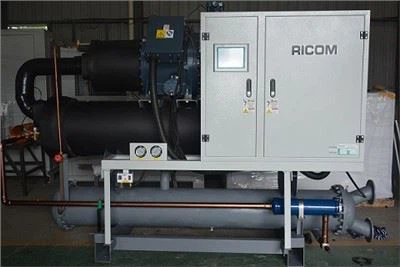
An engineered industrial chiller system is specified around your actual process requirements rather than selected from nominal cooling capacity alone. The engineering basis encompasses cooling load, supply and return temperatures, process fluid properties, flow rate, pump pressure, ambient limits, and control interface requirements.
Removing heat at the exact required temperature, flow, and pressure under real site conditions ensures system efficiency and operational reliability-where standard chillers fall short.
Technical Specification Comparison
|
Parameter |
Engineering Consideration |
Standard Chiller vs. Engineered System |
|
Cooling Capacity |
Calculated from actual heat load and duty cycle |
Fixed nominal rating vs. Custom thermal balance |
|
Supply/Return Temp |
Specified to exact process tolerance (dT) |
Standard 7°C output vs. Wide range (-30°C to +30°C) |
|
Process Fluid |
Water, glycol, or aggressive fluids |
Clean water only vs. Anti-corrosive / Custom wetted parts |
|
Hydraulics |
Matched to total system pressure drop |
Fixed internal pump vs. Application-specific head pressure |
|
Condenser Type |
Air- or water-cooled based on ambient limits |
Standard ambient design vs. High-ambient (>50°C) / Industrial loops |
|
Integration |
Footprint, electrical, and PLC interfacing |
Standalone unit vs. Full OEM/PLC communication (Profinet, Modbus) |
When Do You Need an Engineered System?
Non-Standard Fluid Dynamics: High-viscosity fluids, glycol concentrations over 20%, or corrosive chemical solutions requiring Stainless Steel, Titanium, or Hastelloy heat exchangers.
Extreme Ambient Conditions: High-temperature environments (up to 50°C+) or outdoor sub-zero installations requiring anti-freeze controls.
Strict Hydraulic Constraints: Long pipe runs, narrow channels in OEM machinery, or high elevation differences needing custom pump head pressure.
Tight Mechanical Interfacing: Custom footprints, specific pipe connection orientation, or embedded OEM machine mounting.
Advanced Automation: Integration with plant PLCs via Modbus, Ethernet/IP, or Profinet for automated monitoring and predictive fault signaling.
Core Engineering Requirements
Thermal Load Calculation
Cooling capacity must mirror process heat generation. For liquid-based systems, the heat load formula is expressed as:
Q = m * Cp * dT
(Where Q = cooling duty, m = mass flow rate, Cp = fluid specific heat, and dT = temperature difference between return and supply).
Fluid Compatibility & Glycol Considerations
Water-glycol mixtures alter thermal conductivity and viscosity, increasing pressure drops and altering required heat transfer surface areas.
• Glycol Adjustments: Pure water vs. 30% Ethylene Glycol reduces thermal capacity and increases pump load; heat exchangers and pumps must be sized accordingly.
• Corrosive Environments: Processes involving deionized water, plating fluids, or chemicals require direct material review for all wetted components (pumps, seals, piping, and evaporators).
Condenser Selection Criteria
• Air-Cooled Systems: Ideal when cooling water is unavailable or independent operation is preferred. Sized against maximum site ambient temperatures and airflow clearance.
• Water-Cooled Systems: Ideal when a cooling tower circuit is available or continuous indoor high-duty cooling is needed. Offers high efficiency independent of ambient air temperatures.
Verified Field Application: Case Study
Application: High-Speed Plastic Injection Molding Line.
Heat Load: 180 kW continuous load.
Process Fluid: 20% Propylene Glycol / Water solution.
Supply / Return Temp: +10°C supply / +15°C return.
Required Flow & Pressure: 310 L/min @ 4.5 bar dynamic pressure.
Site Conditions: Outdoor installation, maximum ambient temperature 48°C.
Electrical & Controls: 400V / 3Ph / 50Hz, Siemens PLC with Profinet interface.
Engineering Solution: Custom air-cooled chiller featuring dual-circuit V-coil condensers, oversized EC fans, heavy-duty Stainless Steel pumps, and Titanium plate heat exchangers. Fully tested to ISO 9001 and CE standards prior to dispatch.
Quality Compliance & Factory Verification
To guarantee performance before installation, engineered chillers undergo strict testing protocols:
Refrigeration Circuit Verification: Helium leak detection and pressure testing per PED / ASME standards.
Electrical Safety Testing: EN 60204-1 compliance, phase-sequence checks, and full load current validation.
Full Thermal Run Test: Simulated process load testing recording actual flow, operating pressure, temperature stability, and power draw. Complete factory test reports are delivered with every unit.
FAQ
Hot Tags: engineered industrial chiller system, China engineered industrial chiller system manufacturers, suppliers, industrial chiller for interior design firms, industrial chiller for stadiums, industrial chiller for welding, industrial chiller maintenance, industrial chiller weight, industrial process chiller