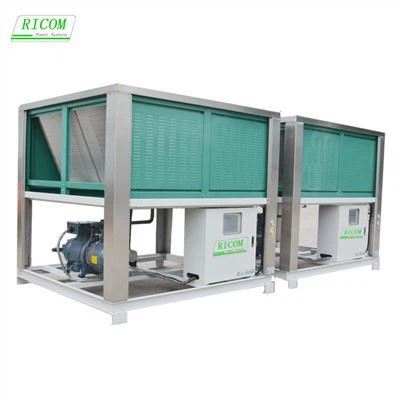
A microprocessor mold temperature controller regulates mold temperature by circulating water or heat-transfer oil through the mold circuit.
The system integrates a microprocessor controller, PID temperature regulation, electric heating, circulation pump, cooling circuit, precision sensors, and comprehensive safety protections. The controller continuously monitors fluid temperature and adjusts heating or cooling output to match the target setpoint.
Key Factors for Controller Selection
Thermal Load: Process setpoint, heat-transfer medium, mold thermal load, heating/cooling capacity, and thermal stability.
Hydraulic Dynamics: Flow rate, pump pressure/head, fluid viscosity, and mold circuit flow resistance.
System Integration: Number of circuits, mold inlet/return connection types (NPT/BSP), plant power supply, and equipment footprint.
Compliance & Operations: Alarm outputs, automation communication protocols, and safety certifications.
Engineer Field Tip on Pressure Drop:
In long cooling channels or multi-cavity molds, high oil viscosity during cold starts causes significant pressure drop. Always size the pump pressure 15% to 20% above theoretical requirements. This ensures turbulent flow (Reynolds number Re > 4000) for maximum heat transfer efficiency and uniform mold surface temperatures.
Microprocessor PID Temperature Control & Energy Efficiency
The system receives real-time thermal feedback from industrial sensors and executes PID calculations to modulate heating and cooling outputs.
Setpoint -> Temperature Sensor -> Microprocessor PID Control -> Heating/Cooling Output -> Mold Circuit -> Thermal Feedback
Precision and Energy Savings:
• SSR / SCR Power Modulation: Solid-State Relays or Thyristors enable high-frequency pulse-width control, maintaining temperature stability within +/- 0.5 deg C.
• Lower Energy Costs: PID power-proportioning prevents temperature overshoot and reduces energy consumption by 15% to 22% compared to conventional ON/OFF heating.
• Dual Thermal Display: High-temperature and oil-type units display both supply and return temperatures, allowing operators to monitor the temperature delta (Delta T) across the mold.
Impact of Mold Temperature Stability
Mold thermal fluctuation directly affects resin flow, crystallization, and part quality. Unstable temperatures cause:
Dimensional variation and uneven shrinkage
Part warpage and internal stress
Surface defects (sink marks, blush, flow lines)
Uncontrolled cycle times and part-to-part inconsistency
Technical Specifications & Component Standard
|
Parameter / Component |
Specification / Standard |
Application Details |
|
Control Accuracy |
+/- 0.5 deg C |
Microprocessor PID control with auto-tuning |
|
Heat-Transfer Medium |
Water or Synthetic Thermal Oil |
Selected based on process temperature |
|
Heating Capacity |
6 kW to 96 kW |
Incoloy 800 / 316L Stainless Steel heating elements |
|
Pump Flow Rate |
40 L/min to 220 L/min |
High-head circulation pump (Magnetic drive optional) |
|
Max Pump Pressure |
2.0 kg/cm2 to 4.5 kg/cm2 |
Overcomes channel backpressure and oil viscosity |
|
Temperature Sensor |
PT100 Class A RTD |
Real-time monitoring of fluid supply and return |
|
Main Electricals |
Schneider / Siemens |
SSR / SCR switching for fast response |
|
Pipe Material |
Seamless 304/316 Stainless Steel |
Corrosion-resistant internal circulation loops |
|
Power Supply |
220V / 380V / 400V / 480V |
3-Phase, 50Hz or 60Hz global voltage compatibility |
|
Pipe Connections |
3/8", 1/2", 3/4", 1" |
Available in BSP (Metric/Euro) or NPT (US) threads |
|
Communication |
RS485 (Modbus-RTU) |
Optional integration with injection molding machines |
|
Certifications |
CE, ISO 9001:2015 |
Compliant with LVD (2014/35/EU) and EMC (2014/30/EU) |
Safety Protection Features
- Main circuit breaker and phase-reversal / phase-loss protection
- Pump overload protection via thermal relays
- Automatic cool-down sequence prior to system shutdown
- High-temperature limit switches and low fluid level alarms
- Overpressure safety relief valves and pressure monitoring
Step-by-Step Selection Guide
Set Operating Temperature: Determine the required process setpoint with an appropriate operating margin.
Select Medium: Choose water for high heat capacity under 120 deg C - 180 deg C; choose thermal oil for setpoints up to 350 deg C.
Calculate Heating Power: Factor in mold mass, material specific heat, ambient temperature, and required heat-up time.
Determine Pump Flow & Pressure: Select a pump that maintains turbulent flow against the flow resistance of the mold channels.
Evaluate Cooling Capacity: Ensure the cooling circuit can extract process heat during continuous cycling.
Confirm Site Utilities: Verify voltage, phase, frequency, connection thread standard, and equipment space.
Quality Verification and Testing
Hydrostatic Leak Test: Tested at 1.5x working pressure to ensure circuit tightness.
Electrical Safety Audit: Insulation, grounding, and high-voltage testing per international standards.
Thermal Functional Test: Full operational run verifying PID stability, pump delivery, auto-cooling, and fault alarms.
Documentation Supplied
Certified dimensional drawings and electrical schematics
Factory quality inspection and pressure test records
Operation and maintenance manual
Recommended spare parts list
Technical RFQ Table for Buyers
|
Parameter |
Buyer Input / Requirement |
|
Application / Polymer Type |
(E.g., Injection Molding / PA66 + 30% GF) |
|
Target Mold Temperature |
Deg C / deg F |
|
Medium Preferred |
Water / Thermal Oil |
|
Mold Weight |
kg / lbs |
|
Target Heat-Up Time |
Minutes |
|
Number of Mold Circuits |
(E.g., 4 In / 4 Out) |
|
Connection Thread Type |
BSP / NPT (Size: 3/8", 1/2", etc.) |
|
Plant Power Supply |
Volts / Phase / Hz |
|
Cooling Water Supply |
Temp: deg C / Pressure: bar |
|
Special Features |
RS485 / SSR Control / Magnetic Drive Pump |
FAQ
Hot Tags: microprocessor mold temperature controller, China microprocessor mold temperature controller manufacturers, suppliers, Precision Industrial Water TCU