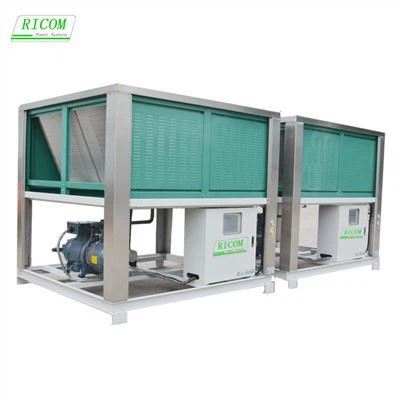
High Temperature Thermal Oil Heating Unit for Industrial Processes
High Temp Thermal Oil Heating Units provide precise, controlled indirect heating and continuous thermal fluid circulation for process equipment operating at elevated temperatures (up to 350°C / 660°F or customized higher) at near-atmospheric pressure.
High Temp Thermal Oil Unit at a Glance
|
Technical Parameter |
Engineering Selection Basis |
Industry Standard / Configuration |
|
Heating Medium |
Thermal oil / Specified synthetic heat transfer fluid |
Synthetic or Mineral Heat Transfer Oils |
|
Operating Temperature |
Required process operating point |
Precise Control up to 300°C / 350°C+ |
|
Heating Capacity |
Process heat load, startup time & thermal loss |
Custom Sizing (15 kW to 1000 kW+) |
|
Circulation Pump |
Required flow rate & system pressure drop |
High-Temp Magnetic / Mechanical Seal Pumps |
|
Control System |
Required process stability & automation level |
PLC Touchscreen / PID Digital Control |
|
Certifications & Compliance |
Regional industrial safety standards |
CE, ASME, ISO 9001, UL / CSA (Optional) |
|
Key Components |
Reliability and continuous operation requirements |
Siemens, Schneider, Omron, SPECK / Dickow |
System Specifications & Engineering Limits
|
Parameter |
Standard Range |
Heavy-Duty / Custom Range |
|
Max Working Temperature |
Up to 300°C (572°F) |
Up to 380°C (716°F) |
|
Heating Capacity Range |
18 kW – 350 kW |
Up to 1200 kW |
|
Temperature Control Accuracy |
± 1.0°C |
± 0.2°C (High precision PID) |
|
Operating System Pressure |
0.2 – 0.5 MPa (Atmospheric) |
Customized High-Pressure Loop |
|
Pump Flow Rate |
3.5 – 120 m³/h |
Custom high-flow pumps |
|
Electrical Voltage Options |
380V / 400V / 415V (50/60 Hz) |
208V / 230V / 460V / 480V / 600V |
When Is a Thermal Oil Unit Suitable?
High Temperatures at Low Pressure: Eliminates the safety hazards and high maintenance of high-pressure steam boilers.
Precise Temperature Control: Maintains steady surface temperatures within ±1°C for heat-sensitive materials.
Multi-Zone Heat Distribution: A single master unit can feed multiple heating zones operating at different temperatures.
Target Applications: Chemical reactors, jacketed vessels, extruders, heated molds, vulcanization presses, composite tooling, heated rollers, calenders, and drying lines.
How to Select the Right Thermal Oil Unit
Common Selection Mistake: Choosing a system based only on maximum temperature or heater kW rating often leads to insufficient oil circulation, heater burnout, or slow cycle times.
Define Process Temperature & Fluid Properties: Specify normal operating temperature, maximum required temperature, and supply vs. return oil temperature difference (Delta T). Select a fluid with appropriate viscosity, flash point, and thermal stability for your operating zone.
Calculate Heating Capacity (Heat Load): Heating capacity must cover material heat-up load, equipment thermal mass, and piping/surface heat losses.
Balance Heating Capacity, Oil Flow, and Delta T: Heat Load = Mass Flow Rate x Specific Heat x Delta T. Reducing Delta T improves process uniformity, but requires a higher oil flow rate and larger pipe sizes.
Determine Pump Flow and Pressure Head: The pump must deliver the calculated flow rate while overcoming system friction across internal heater elements, external distribution piping, valves/fittings, and process equipment channels.
System Components & Safety Architecture
Electric Heating Assembly: Low watt-density heating elements prevent localized oil overheating and fluid carbonization.
Industrial Circulation Pump: High-temperature mechanical seal or leak-free magnetic drive pumps (SPECK, Dickow, or equivalent).
Thermal Expansion Tank: Accommodates fluid expansion and acts as a buffer against fluid oxidation.
Multi-Layer Safety Interlocks: Low flow switch, over-temperature limiters, expansion tank low-level alarms, and pump overload protection.
Quality Control & Manufacturing Standards
Hydraulic Pressure Test: Pressure tested at 1.5x design pressure to ensure zero leakage.
Electrical Safety & Insulation: Full wiring verification compliant with IEC/EN standards.
Functional Test: Pump rotation, sensor calibration, PID tuning, and safety alarm simulation.
Documentation Delivered: Detailed P&ID drawings, electrical schematics, spare parts list, maintenance manuals, and factory test reports.
Technical Datasheet for RFQ
|
Required Information |
Buyer Input / Project Specification |
|
Process Equipment Type |
(E.g., Reactor, Heated Roller, Mold, Hot Press) |
|
Required Operating Temp |
°C / °F |
|
Required Heating Capacity |
KW or kcal/h (or specify target startup time) |
|
Thermal Fluid Selected |
(E.g., Synthetic Oil, Mineral Oil, or Unknown) |
|
Target Oil Delta T (Supply - Return) |
°C (Default is typically 10–20°C) |
|
Electrical Supply |
Voltage / Phase / Frequency (e.g., 380V / 3Ph / 50Hz) |
|
Control & Automation |
(E.g., Local Digital Panel, PLC Touchscreen, Modbus/Profibus) |
|
Compliance Required |
(E.g., CE, ASME, Explosion-proof Ex-proof) |
FAQ
Hot Tags: high temp thermal oil unit, China high temp thermal oil unit manufacturers, suppliers, Centralized Mold Water Temperature Controller