

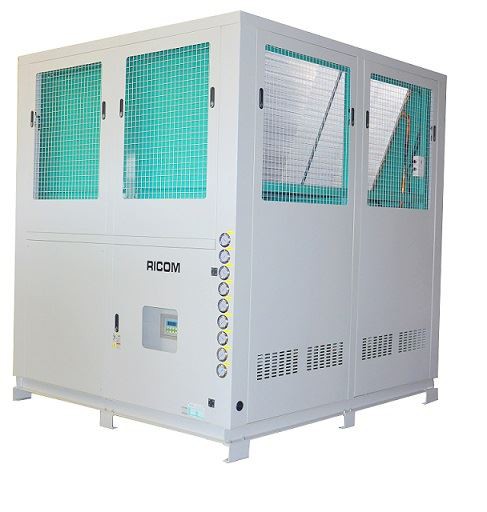



Industrial chiller is a kind of chiller, which can be divided into air cooled industrial water chiller and water cooled industrial chiller. It is a water cooling device that can provide constant temperature, constant current and constant pressure. The principle is to inject a certain amount of water into the internal water tank of the machine, cool the water through the chiller refrigeration system, and then inject the low-temperature frozen water into the equipment that needs to be cooled by the water pump inside the machine, and the chilled water will take away the heat inside the machine, The high-temperature hot water is returned to the water tank for cooling again, so as to circulate and exchange cooling to achieve the effect of cooling the equipment.
Refrigeration Technology

Industrial chillers typically come as complete packaged closed-loop systems, including hot and cold water units, condenser and circulation pumps, expansion valves, no-flow shut-offs, internal cold water tanks, and temperature control stations. Internal water tank helps maintain cold water temperature and prevent temperature spikes. Closed-loop industrial chillers recirculate water at constant temperature and pressure to increase stability and repeatability for cooling equipment and instrument cleaners or clean water. The cooling of the water flow is applied to the angle of use and back.
If there is a high temperature difference between the incoming and outgoing water, a large external tank will be used to store cold water. In this case, the cooling water is not used directly from the cooler application, but rather deep into the outside of the tank acts as a sort of 'temperature buffer. The cold water tank is much larger than the internal water tank. Cold water is applied from the external fuel tank Program and return hot water from the application can be traced back to the external fuel tank, not to the unit.
One of the new developments in industrial chillers is the use of air-cooled cooling instead of cooling water. In this case, the condenser is not cooled with hot air refrigerant, but is used by cooling water from the cooling tower. This development allows more than 15% and allows for a substantial reduction in energy demand in coolers due to the small area of surface water, in the case of condensers and fans. In addition, the noise level is greatly reduced where the fan allows.
Most industrial chillers use a cooling medium for cooling, but some rely on simple technologies such as air or water that involve the flow of cooling coils to regulate temperature. Water is the most commonly used coolant in freezing processes, although cooling mixtures (mainly water with coolant additives to enhance heat dissipation) are often employed.
Composition
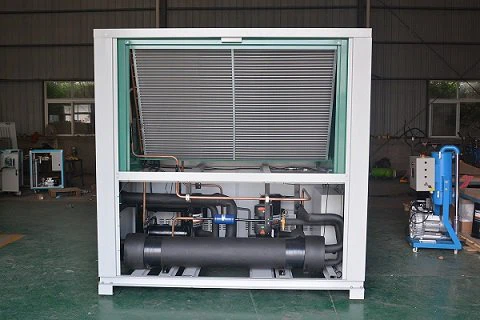
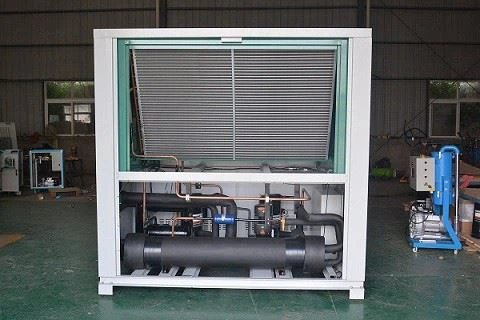
The operation of the industrial chiller system works through three interconnected systems: refrigerant circulation system, water circulation system, and electrical automatic control system.
Refrigeration cycle
The liquid refrigerant in the evaporator absorbs the heat in the water and starts to evaporate. Finally, a certain temperature difference is formed between the refrigerant and the water, and the liquid refrigerant also completely evaporates into a gaseous state, which is then sucked in and compressed by the compressor (the pressure and temperature increase), the gaseous refrigerant releases heat through the condenser (air-cooled/water-cooled) and condenses into a liquid. After throttling through the expansion valve (or capillary), it becomes a low temperature and low pressure refrigerant and enters the evaporator to complete the refrigerant cycle process.
Water cycle
The water pump is responsible for pumping water from the water tank to the equipment that the user needs to cool. The chilled water takes away the heat and then the temperature rises, and then returns to the chilled water tank.
Electrical control
Including the power supply part and the automatic control part.
The power supply part supplies power to compressors, fans, water pumps, etc. through contactors.
The automatic control part includes thermostat, pressure protection, delay device, relay, overload protection and other phases.
The mutual combination achieves the functions of automatic start and stop according to the water temperature, protection and other functions.

Generally, water-cooled heat dissipation is used above 10P, and air-cooled heat dissipation is used below 10P.
Air cooled industrial water chillers are generally integrated machines, together with evaporators, compressors and condensers. For a slightly higher power air cooled industrial water chiller, it is necessary to consider the heat dissipation problem of the condenser cooling fan when it is working. For applications in air-conditioning workshops, the whole machine needs to be equipped with an exhaust duct to lead the heat blown by the cooling fan to the outside.
The air cooled industrial water chiller can also be made into a split type, the condenser is directly placed outdoors (called an outdoor unit), and the evaporator and compressor are placed indoors (called an indoor unit). However, considering the heat absorption of the refrigerant during the transmission between the condenser and the evaporator, the distance between the indoor unit and the outdoor unit is preferably controlled within 6 meters. In addition, the copper pipes transporting the refrigerant need to be insulated. The power supply cable and control cable of the fan can be routed together with the copper pipe, so that the air conditioning plant only needs to open the hole and pass through the pipe.
For industrial applications where small flow and small heat dissipation air-cooled chillers are used, the integral type is generally used directly, and the heat dissipation problem can be ignored at this time. For air-cooled chillers with large flow and large heat dissipation, the split type can be selected.
The cooling effect of the condenser of the air-cooled chiller is slightly affected by the seasonal climate change of the external environment, while the water-cooled chiller adopts a water tower for a relatively stable heat dissipation effect, but its disadvantage is that a water tower is required and the mobility is poor.
Working principle diagram:

The air-cooled chiller uses a shell-and-tube evaporator to exchange heat between water and refrigerant. The refrigerant system absorbs the heat load from the water, cools the water to produce cold water, and transfers the heat to the finned condenser through the action of the compressor. Then it is dissipated into the outside air by the cooling fan (wind cooling)
Features:
1. The air-cooled chiller does not need to be connected to a cooling water tower, and is suitable for environments with poor impurities. (Impurities are easily mixed in the cold water tower, and the dust causes the cooling water circulation circuit to be blocked, resulting in a decrease in cooling capacity).
2. Air-cooled chillers are most suitable for areas with poor water quality, which can save other accessories for cold water towers.
3. Using a large-capacity condenser, it can run easily even in hot weather.
4. Minimize floor space and easy installation.
5. The air-cooled chiller adopts the top-out air design.
Application
Chillers are widely used in plastics, electroplating, electronics, chemicals, pharmaceuticals, printing, food processing and other industrial freezing processes that require frozen water, or can also be used for villas, restaurants, hotels, institutions, schools, factories, etc. The space provides comfort in air-conditioned areas. Due to the wide range of uses and application fields of chillers, it is impossible to list them all here. The following only briefly introduces some of the applicable industries where chillers are most used in the industrial industry:
Industrial chillers (temperature range: +20°C to -25°C adjustable) are widely used in a variety of industrial production - 1. Chemical (science) industry 2. Plastic products, plastic containers, film making, plastic steel profiles, pipes, wires , cable sheath, tire industry 3. Electroplating and machine tool cutting fluid cooling industry 4. Pharmaceutical industry 5. Electronics industry 6. Hardware industry 7. Food and beverage industry 8. Footwear industry 9. Laboratory 10. Medical equipment 11. Optics instruments, etc.
1. Chemical Industry
It is mainly used for the cooling and cooling of chemical reaction kettles (chemical heat exchangers), to take away the huge heat generated by chemical reactions in time to achieve the purpose of cooling (cooling) to improve product quality.
2. Manufacturing industry of plastic products, plastic containers, food packaging films, medical packaging films, etc.
In the injection molding process of plastic products (TVs, computers, washing machines, mobile phones, refrigerators, air conditioners, plastic toys, automotive plastic accessories, etc.), whether the cooling (cooling) can be timely and effective will directly affect the appearance of the products and the qualified appearance. rate, thereby affecting production efficiency, production costs and corporate profits.
The production of plastic containers (bottle blowing) and packaging films is even more inseparable from chillers. If the plastic container cannot be cooled and shaped in time during the production process, the produced container will not be full, the wall thickness will be uneven, the color will not be bright, or even unable to be formed, resulting in lower product quality. In the production of packaging film, if there is no cooling and forming of cold water (wind), qualified products cannot be produced. If the cold water (air) provided by the chiller (ice water machine) is used for cooling, it can not only greatly improve the product quality, but also improve the production efficiency.
3. Cooling of electroplating liquid, hydraulic oil and machine tool cutting tool coolant
In electroplating production, the electroplating solution generates heat continuously in the electroplating reaction, so that the temperature of the electroplating solution increases gradually. , flatness and surface finish have a greater impact. Choosing to use the chilled water provided by the chiller to cool and maintain the constant temperature of the electroplating solution will greatly improve the electroplating production process and production efficiency.
The cooling of the coolant of the machine tool cutting tool and the control of the temperature of the tool edge will directly affect the service life of the tool and the quality of the product.
4. Pharmaceutical Industry
The pharmaceutical industry is mainly used for the control of temperature and humidity in the production workshop and the removal of reaction heat during the production of APIs.
5. Electronics industry
In the production process of electronic components, it is necessary to keep or cool the components at a specific temperature, so that the performance parameters of electronic components can be controlled in the designed state.
Internal structure
1.compressor | 7.Capillary (Expansion Valve) |
2.High pressure gauge | 8.Evaporator |
3.High voltage protector | 9.water pump |
4.condenser | 10.Low pressure gauge |
5.Cooling fan | 11.Low voltage protector |
6.filter dryer | 12.water valve switch |
Configuration structure
1. High quality compressor
As the heart of the chiller, the chiller adopts the new imported high-quality original compressor from Europe, America and Japan, with built-in safety protection, low noise, power saving and durability;
2. Water tank evaporator
Stainless steel thick water tank evaporator, built-in automatic water replenishment and other devices, eliminating the need for expansion water tank in engineering installation, convenient installation and maintenance, and suitable for special occasions such as large temperature difference and small flow;
3. Water-cooled condenser
It is made of the latest high-efficiency external threaded copper tube, with large heat dissipation, small size, high efficiency and energy saving.
4. Air-cooled condenser
High-speed punching, reliable quality, secondary flanging, more compact contact between copper tubes and fins, high heat exchange efficiency, new imported copper tubes and automatic elbow welding, greatly enhances oxygen tightness and prevents refrigerant leakage. ;Especially suitable for areas with water scarcity or high water hardness
5. Unit configuration
Equipped with a single-chip control system, built-in compressor drier filter and expansion valve, maintenance hand valve interface and other devices, to ensure the reliable and safe operation of the machine, and to facilitate maintenance.
Industry-wide success stories are shared for your reference

Product parameters(R407C)
Technical Parameters of Air - Cooled Scroll Chiller(Ⅰ) | |||||||
Model | SCA-05 | SCA-08 | SCA-10-Ⅱ | SCA-15-Ⅲ | SCA-20-Ⅱ | SCA-25-Ⅱ | |
Refrigerating capacity (Kca/lKw/Rt/h) | 13583.7Kca 15.8KW 4.5Rt | 21733.2Kca 25.3KW 7.2Rt | 27167.4Kca 31.59KW 9Rt | 40751.1Kca 47.4KW 13.5Rt | 54334.8Kca 63.18KW 18Rt | 67918.5Kca 79KW 22.5Rt | |
Refrigerant | R407C | ||||||
compressor power(HP) | 5 | 8 | 10 | 15 | 20 | 25 | |
Circulating pump power(Hp) | 0.75 | 1 | 1/1.5 | 1.5/2 | 1.5/2 | 2/3 | |
Cooling fan | Diameter(mm) | 550 | 600 | 500 | 550 | 600 | 630 |
Air Volume(m³/h )
| 6487 | 10820 | 2*6264 | 2*8487 | 2*10820 | 2*12220 | |
Chilled drainage piping | Pipe diameter | 1" | 1.5" | 1.5" | 2" | 2" | 2.5" |
Flow(m³/h) | 2.74 | 4.27 | 4.27 | 8.59 | 8.59 | 14.55 | |
Supply voltage | AC380V50HZ3PH AC440V50HZ3PH AC220V60HZ3PH | ||||||
Description: 1.The cooling capacity is based on evaporating temperature: 7℃, condenser temperature: 50℃, refrigerant: R407C, cooling water temperature: 32-37℃ 2.Optional refrigerant:R134A / R404A / R22 | |||||||
Technical Parameters of Air - Cooled Scroll Chiller(Ⅱ) | ||||||
Model | SCA-30-Ⅱ | SCA-40 | SCA-50 | SCA-60 | SCA-80 | |
Refrigerating capacity (Kcal/h) | 81502.2Kca 94.77KW 27Rt | 108669.6Kca 126.36KW 36Rt | 135837Kca 158KW 45Rt | 163004.4Kca 189.5KW 53.9Rt | 217339.2Kca 252.72KW 71.9Rt | |
Refrigerant | R407C | |||||
Compressor power(HP) | 30 | 40 | 50 | 60 | 80 | |
Circulating pump power(Hp) | 3/4 | 40HP以上根据客户要求配置 40HP and above are configured according to customer requirements | ||||
Cooling fan | Diameter(mm) | 700 | 750 | 630 | 700 | 750 |
Air Volume(m³/h)
| 2*15000 | 2*19000 | 3*12220 | 3*15000 | 3*19000 | |
Chilled drainage piping | Pipe diameter | 2.5" | 3" | 3" | 4" | 4" |
Flow(m³/h) | 14.55 | 22.06 | 22.06 | 42.2 | 42.2 | |
Supply voltage | AC380V50HZ3PH AC440V50HZ3PH AC220V60HZ3PH | |||||
Description: 1.The cooling capacity is based on evaporating temperature: 7℃, condenser temperature: 50℃, refrigerant: R407C, cooling water temperature: 32-37℃ 2.Optional refrigerant:R134A / R404A / R22 | ||||||
Technical Parameters of Air-Cooled Screw Chiller | ||||||||
Model | RC2-40A | RC2-50A | RC2-60A | RC2-80A | RC2-90A | RC2-100A | RC2-120A | |
Refrigerating capacity (Kca/lKw/Rt/h) | 102856Kca 119.6KW 34Rt | 132870Kca 154.5KW 43.9Rt | 149124Kca 173.4KW 49.3Rt | 198230Kca 230.5KW 65.5Rt | 248110Kca 288.5KW 82Rt | 271330Kca 315.5KW 89.7Rt | 320006Kca 372.1KW 105.8Rt | |
Refrigerant | R407C | |||||||
Compressor Power(Hp) | 40 | 50 | 60 | 80 | 90 | 100 | 120 | |
Supply voltage | AC380V50HZ3PH/ AC440V50HZ3PH/ AC220V60HZ3PH | |||||||
Energy regulation mode | 25%-50%-75%-100% | |||||||
Starting mode | Y/▲ | Y/▲ | Y/▲ | Y/▲ | Y/▲ | Y/▲ | Y/▲ | |
Piping of cooling water system | Pipe diameter | 3" | 3" | 3" | 3" | 4" | 4" | 4" |
Description: 1.The cooling capacity is based on evaporating temperature: 7℃, condenser temperature: 50℃, refrigerant: R407C, cooling water temperature: 32-37℃ 2.Optional refrigerant:R134A / R404A / R22 | ||||||||
Pass the Iso9001 quality system certification and CE certification


Hot Tags: air cooled industrial water chiller, China, manufacturers, suppliers, wholesale, price, quotation, for sale, industrial chiller technology, industrial chiller for breweries, industrial water cooled chiller, knob for box type chiller, industrial chiller for aquaculture, button for box type chiller